The Heritage & Research Center at Saint Mary's  

The Art of Sacred Work
 

The Sisters of the Most Precious Blood have given form to faith through needle, thread, glass, wood, and metal. The Ecclesiastical Art Department stands as one of the most enduring and celebrated liturgical studios in American Catholic history.

Established in 1858 as an embroidery guild in Germany to sustain their growing community, the Sisters of the Most Precious Blood (CPPS) relocated their studio to O'Fallon, Missouri, in the 1870s. What began as a means of financial support grew into one of the finest ecclesiastical art studios in the United States — one that continues to craft custom liturgical vestments, furnishings, and sacred art to this day.

🏅

Gold Medal — 1904 St. Louis World's Fair

The department received international recognition when a hand-stitched chasuble crafted by the sisters won a gold medal at the 1904 Louisiana Purchase Exposition in St. Louis — competing against the finest liturgical workshops in Europe.

Noted Artisans

Under the direction of Sister Anselma Lange and Sister Hiltrudis Powers, the studio expanded far beyond embroidery into stained glass, woodwork, and metalwork — transforming the department into a full ecclesiastical arts studio serving parishes and institutions across the country.

Vatican Commission — 1999

The department was commissioned to create a stole and mitre for Pope John Paul II's historic 1999 pastoral visit to St. Louis — a testament to the international stature and spiritual trust placed in the sisters' craftsmanship.


1
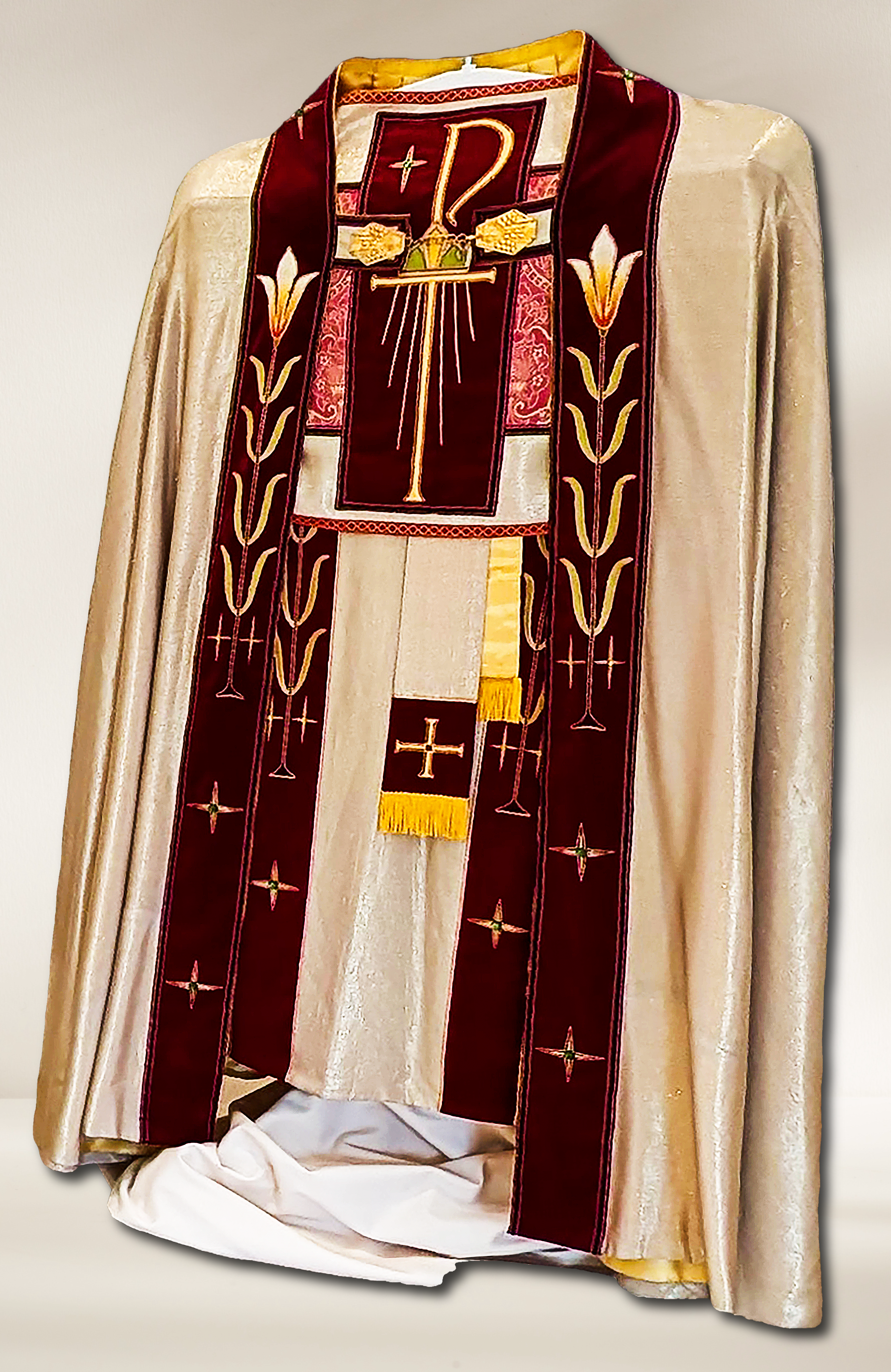
Golden Dalmatic Vestment by Sister Anselma Lang

Exhibit Item 1

Golden Dalmatic Vestment

Sister Anselma Lange · Sisters of the Most Precious Blood


This richly embroidered golden dalmatic vestment was created by Sister Anselma Lange, one of the foundational artists of the Ecclesiastical Art Department. A dalmatic is the outer liturgical garment worn by a deacon during Mass — a wide-sleeved tunic layered over the alb, shaped by centuries of sacred tradition.

The golden ground and intricate needlework are characteristic of Sister Anselma's mastery of ecclesiastical embroidery — a technique requiring painstaking precision in the application of silk and metallic threads. Vestments like this one were produced for churches and cathedrals across the United States, bringing the elevated craft of the O'Fallon studio into the sanctuaries of American Catholic life.
2
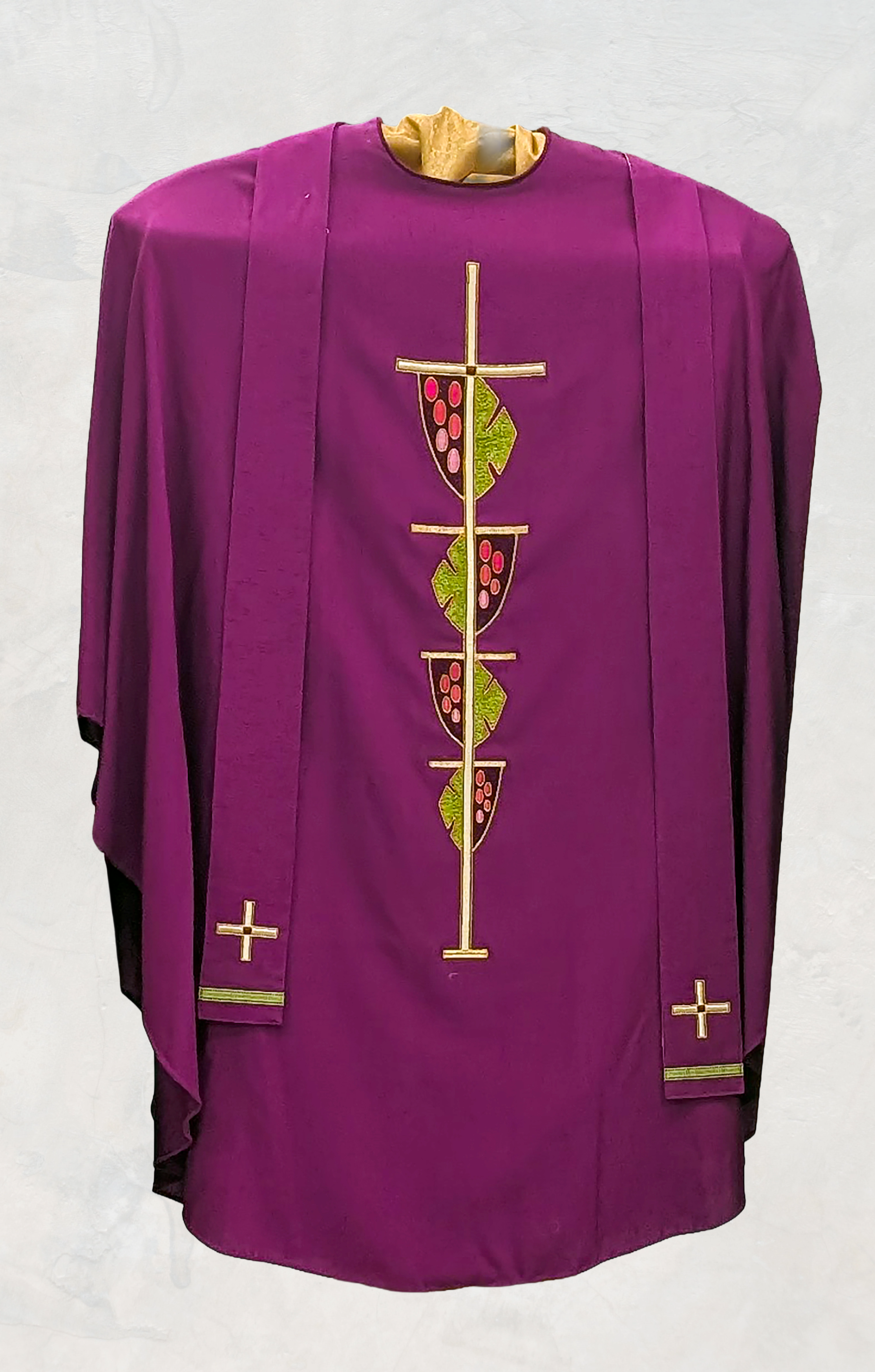
Purple Vestment with Grapes and Leaves by Sister Hiltrudis Powers

Exhibit Item 2

Purple Vestment — Grape and Leaves

Sister Hiltrudis Powers · circa 1970s


Embroidered in deep liturgical purple and adorned with the motif of grapes and leaves, this vestment was created by Sister Hiltrudis Powers in the 1970s. Sister Hiltrudis served as a leading artistic force in the studio's mid-century expansion, guiding the department into new media while maintaining its roots in the embroidery tradition.

The grape and vine motif carries deep Eucharistic significance — the fruit of the vine transformed, as Christ taught at the Last Supper, into the blood of the covenant. Purple, the liturgical color of penitence and preparation, frames this symbolism in the solemnity of Advent and Lent. The pairing of color and imagery reflects the theological intentionality that distinguished the O'Fallon studio from purely decorative needlework.

3
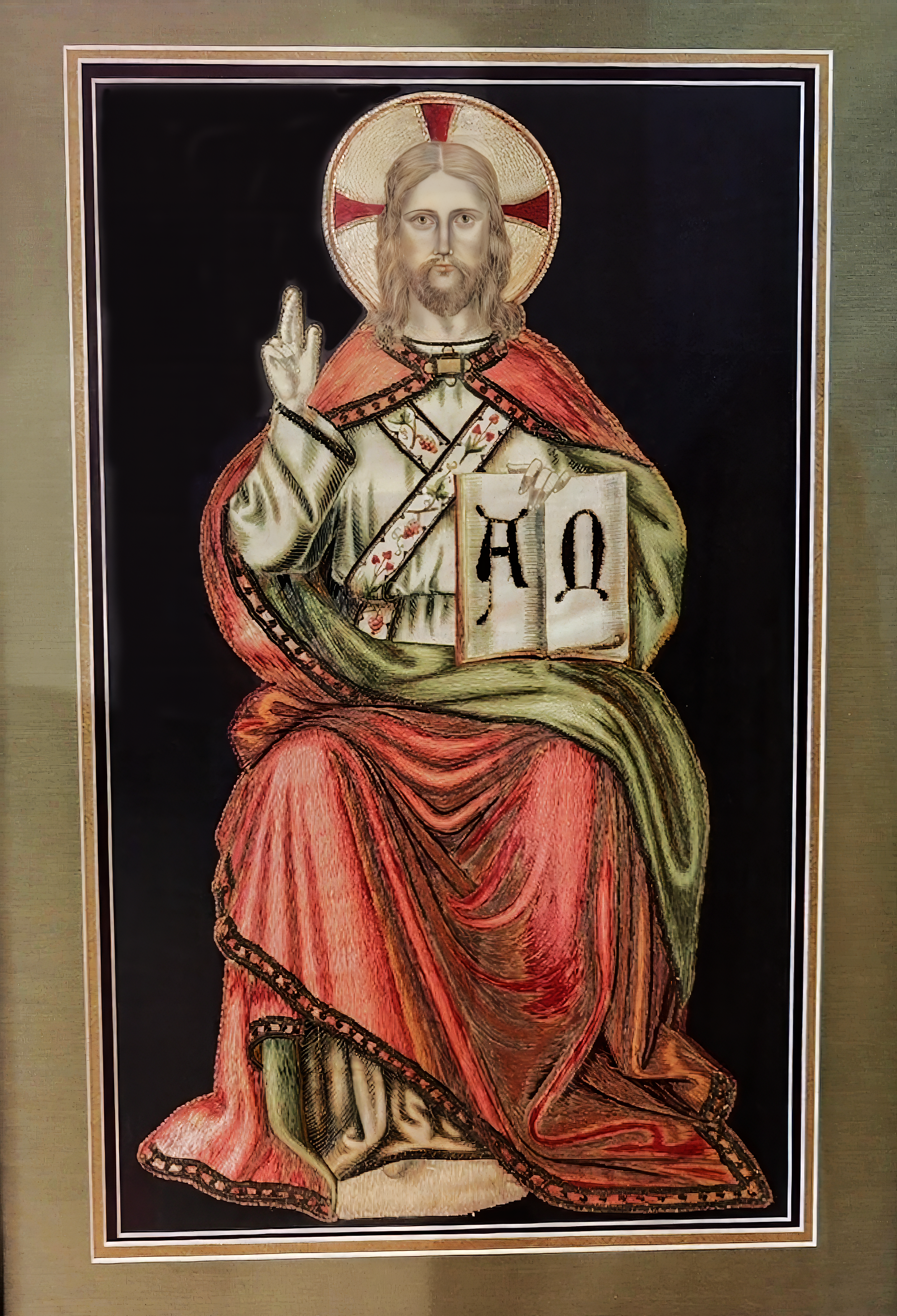
Christ the Teacher Embroidered Fabric Framed by Sister Anselma Lange

Exhibit Item 3

Christ the Teacher — Embroidered Fabric, Framed

Sister Anselma Lange · 1920s


Painted by Sister Anselma Lange in the 1920s, this framed embroidered panel depicts Christ the Teacher — one of the central iconographic traditions of Catholic devotional art, portraying Jesus as the supreme teacher and guide of all wisdom. The decision to frame and preserve this work as an independent pictorial piece, rather than as vestment ornamentation, speaks to the fine-art ambitions of the O'Fallon studio.

Embroidered figurative works of this complexity required exceptional skill in shading, blending, and the management of silk threads across curved forms — techniques that Sister Anselma refined over decades of practice. This piece stands as a testament to the studio's capacity to move between functional liturgical craft and devotional fine art with equal command.

4
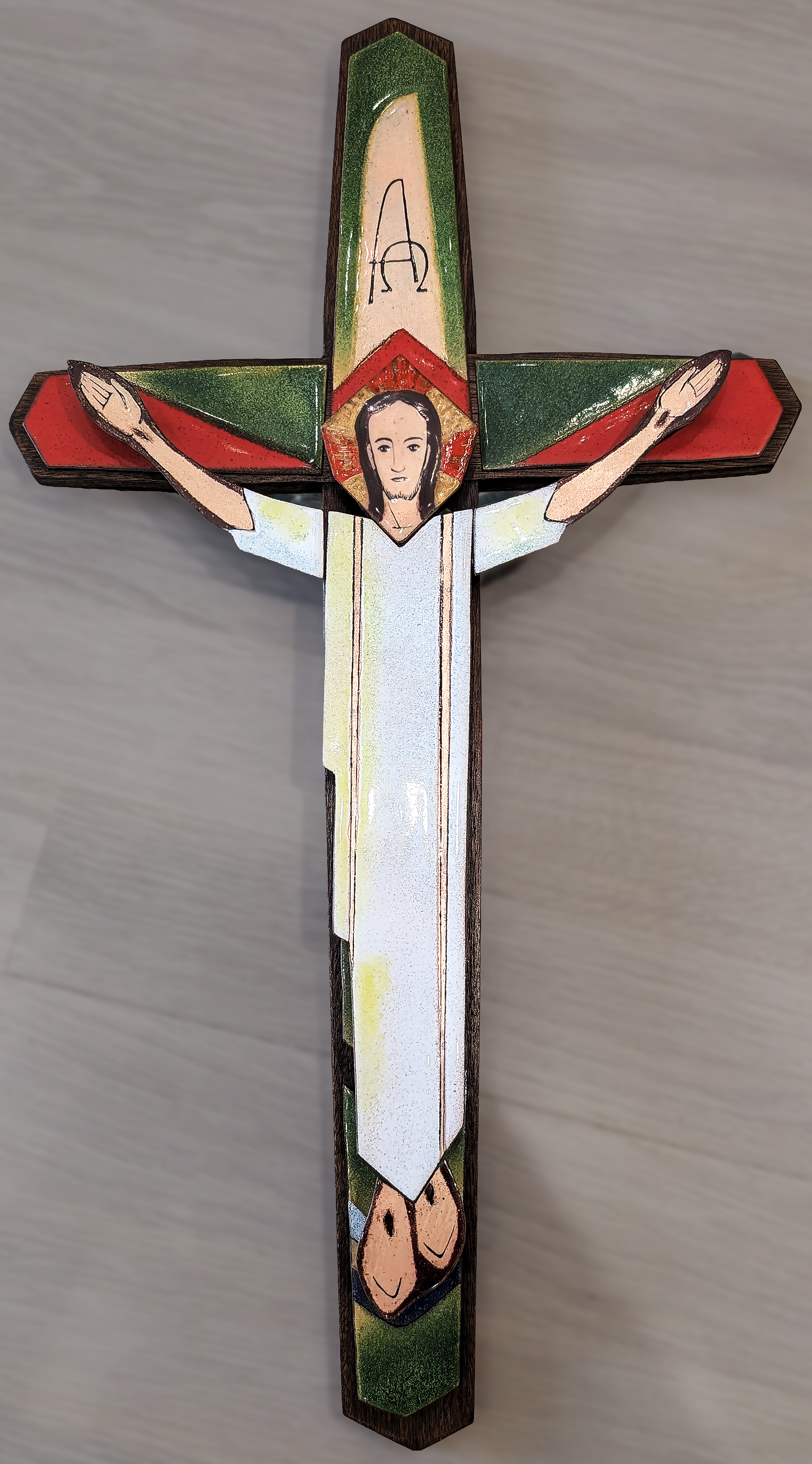
Cross-Resurrection with Alpha and Omega — Wood, Enamel and Copper, 1976

Exhibit Item 4

Cross-Resurrection with Alpha & Omega

Sister Celestine · Wood, Enamel & Copper · 1976


This wooden cross with enamel and copper elements was designed by Sister Celestine while working in Sister Studios at the motherhouse in O'Fallon, Missouri in 1976. The cross incorporates the Alpha (Α) and Omega (Ω) — the first and last letters of the Greek alphabet — a title Christ claims in the Book of Revelation: "I am the Alpha and the Omega, the beginning and the end."

A brass plaque at the base records that the cross was originally given as a gift to the sisters at Saint Sabina's Parish in Florissant, Missouri, where it served the community in worship. In later years it was returned and displayed at the motherhouse in O'Fallon. The cross can be viewed in HARC's ArchivesSpace finding aid.

5
The Good Shepherd

Exhibit Item 5

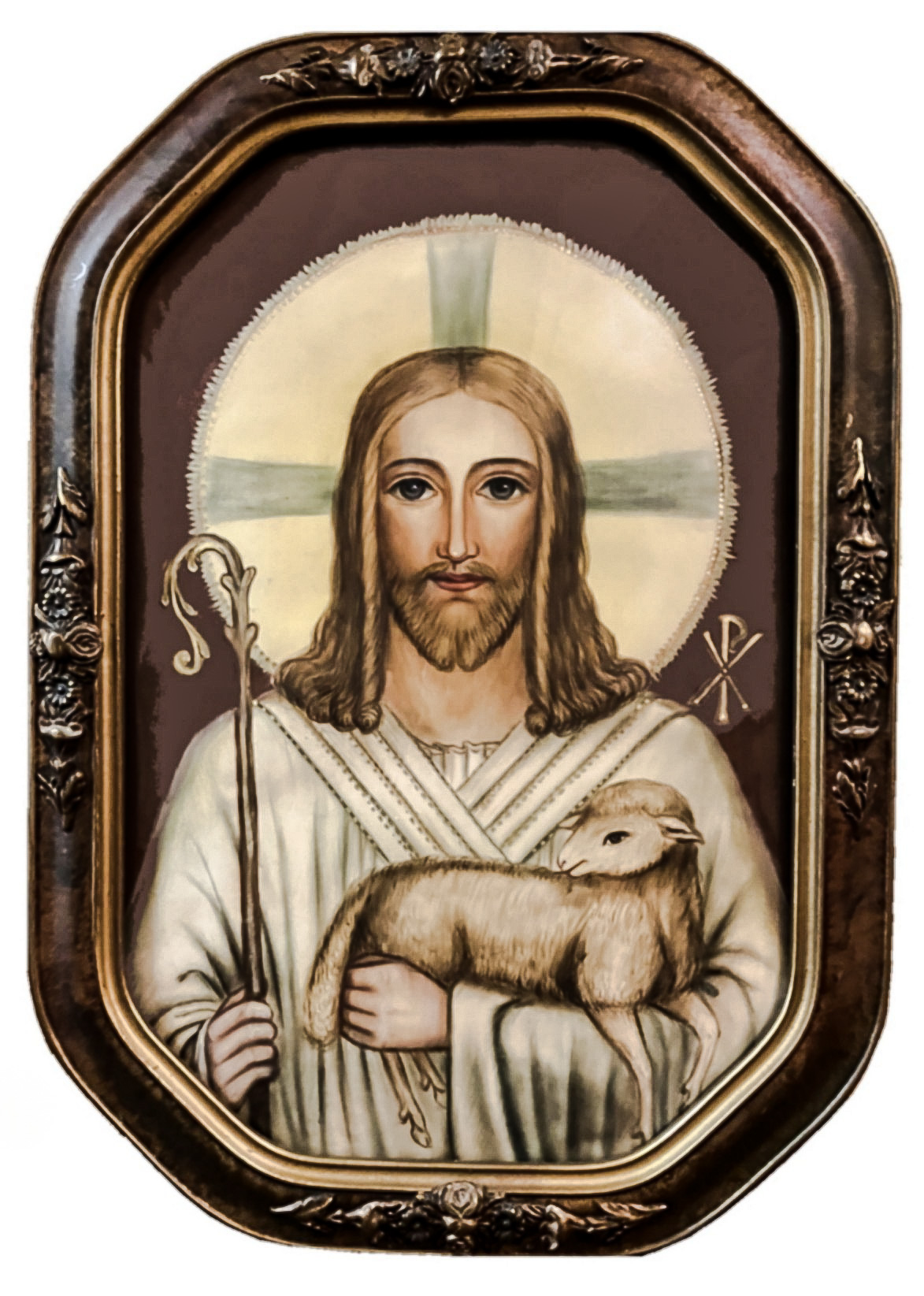
The Good Shepherd (Christ holding lamb)

Sister Anselma Lange; Satin, Painted; 1931


The painted silk piece entitled "The Good Shepherd (Christ holding lamb) was created by Sister Anselma Lange. The work of art was won by Mrs. Henry Abel at the picnic honoring the dedication of the new novitiate building. The painting was originally hung in one of the Ecclesiastical Art Department workrooms. The painting is 16" L x 11" W. The cross can be viewed in HARC's ArchivesSpace finding aid.

6
The Good Shepherd

Exhibit Item 6

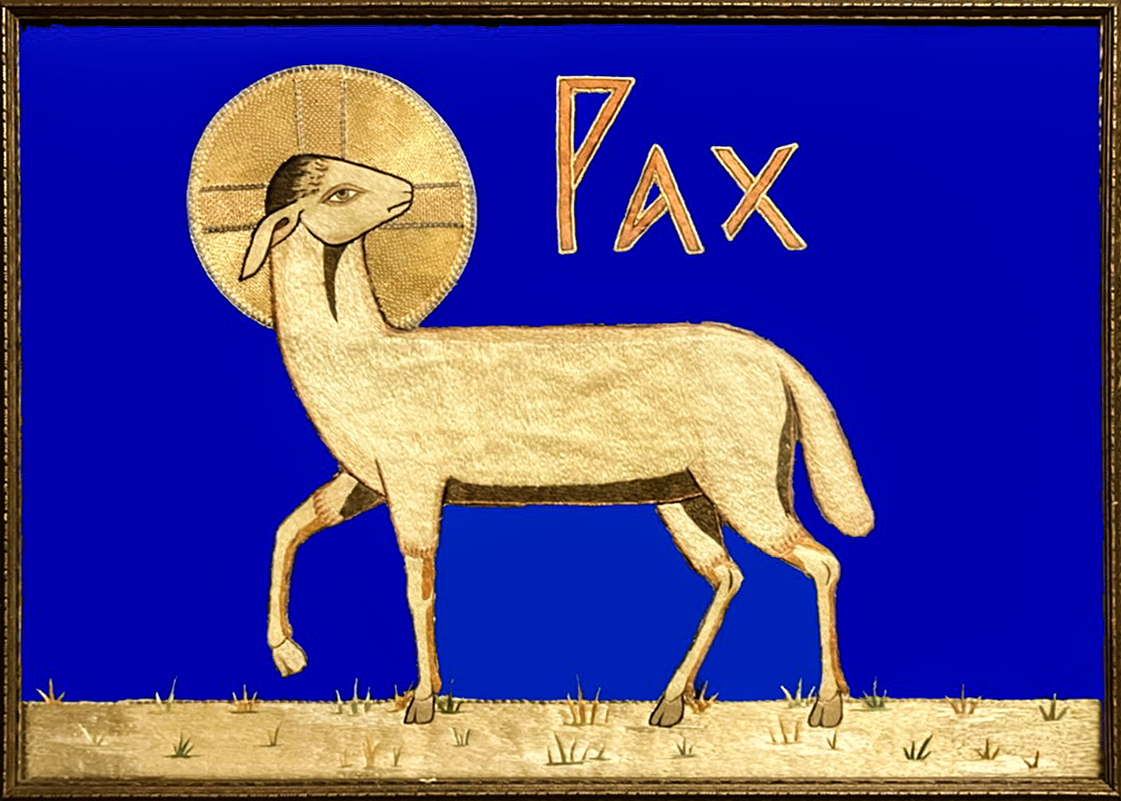
PAX (Peace Lamb)

Sister Anselma Lange and Sister Angelita Dittmaier; Silk Embroidery; 1930s


The silk embroidered piece was designed by Sister Anselma Lange, who was director of the Ecclesiastical Art Department from 1905 to 1945. The Department used the PAX and lamb symbol in much of its art, cards, banners, paintings, wall paintings, liturgical garments, and displays. The writing on the back of the piece states that the piece was stitched by Sister Angelita Dittmaier in the 1930s. -- written by Sister Mary Beth KemperArchivesSpace finding aid.

7
Red Silk Stole Presented to Pope John Paul II

Exhibit Item 7

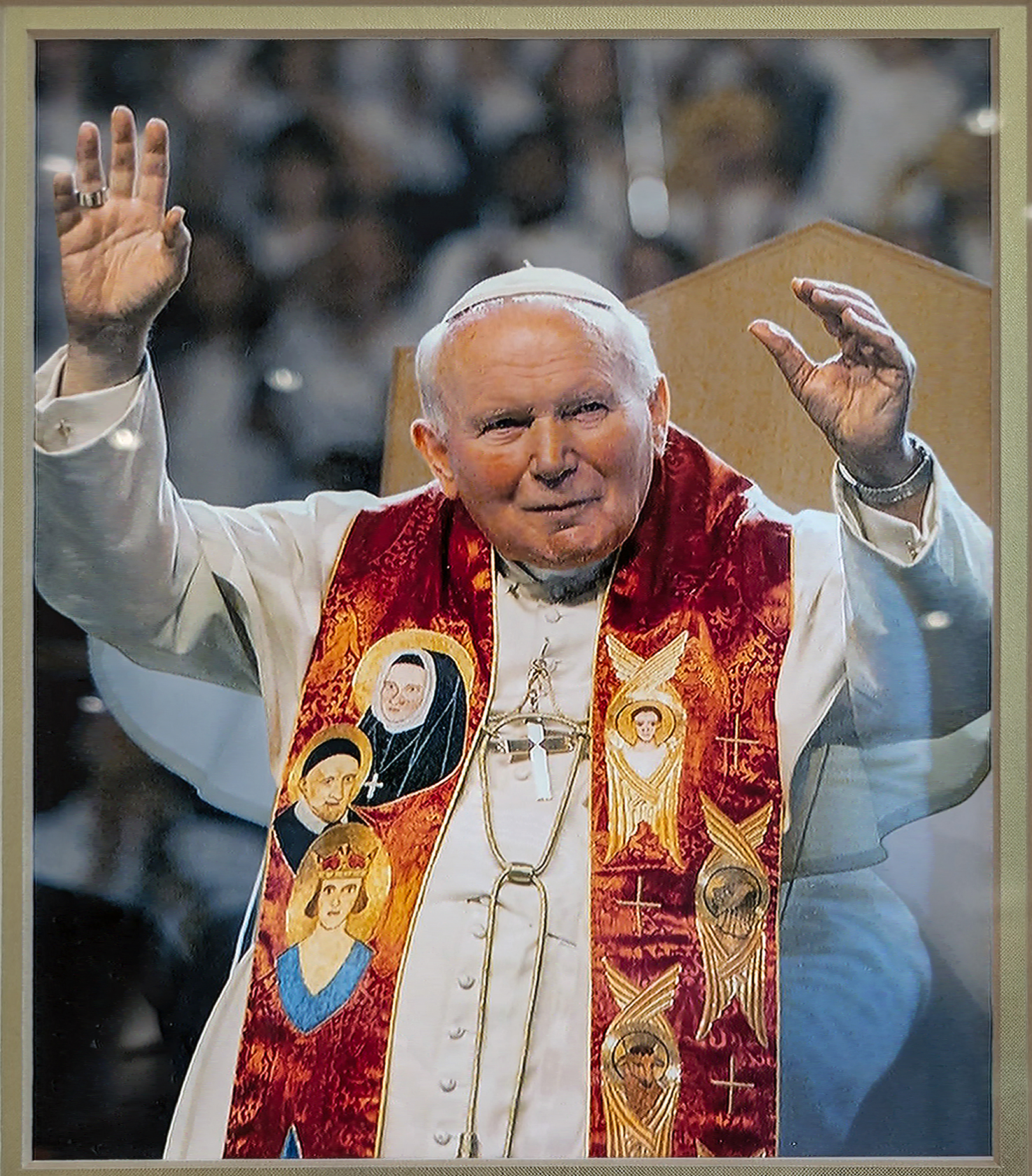
Red Silk Stole Presented to Pope John Paul II

Sister Hiltrudis Powers; Silk Embroidery; 1990s


This red silk stole was presented to Pope John Paul II during his visit to St. Louis in January 1999. He wore it at the youth prayer rally at Kiel Center on January 26 and returned it to the St. Louis Archdiocese, where it is now on display in the cathedral crypt. Hand-embroidered on the right side of the stole are the three primary patron saints of the St. Louis Archdiocese: St. Rose Philippine Duchesne, St. Vincent de Paul, and St. Louis IX, King of France. On the left side, framed in embroidered gold wings, are images of the four evangelists, Matthew (man), Mark (lion), Luke (ox), and John (eagle-not shown). Not visible at the bottom of the stole is the fleur-de-lis and the papal coat of arms. The stole was designed by Sister Hiltrudis Powers, CPPS, and stitched by several members of the Ecclesiastical Art Department of the Sisters of the Most Precious Blood of O’Fallon, Missouri.ArchivesSpace finding aid.

8
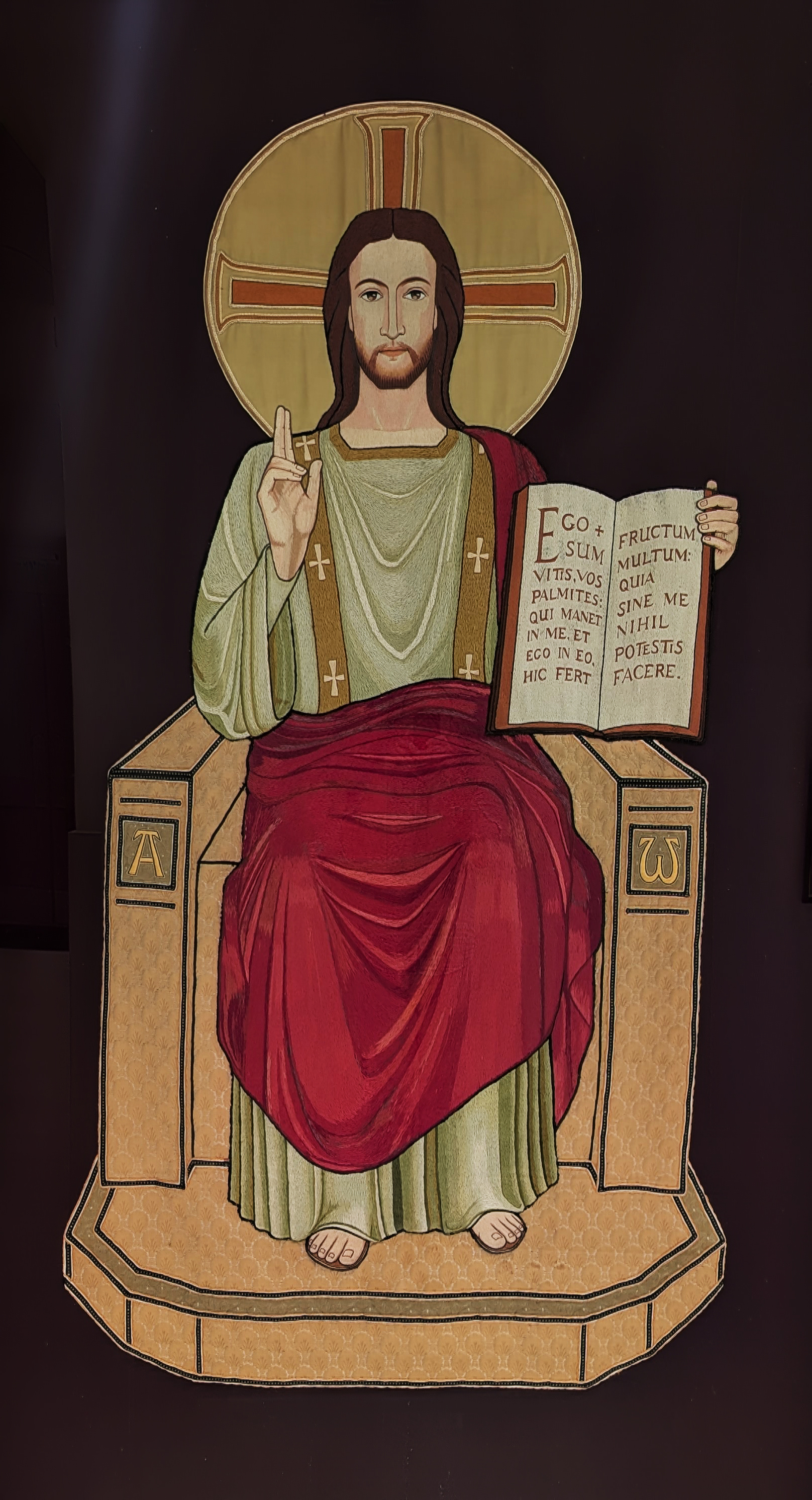
Christ the Teacher Enthroned

Exhibit Item 8

Christ the Teacher Enthroned

Sister hiltrudis powers; Silk Embroidery; 1940s


Christ the Teacher Enthroned is a 91" x 75" embroidered applique on burgundy fabric, mounted and framed. The stitched piece was found in the Ecclesiastical Art Department's attic storage without identifying information. In 2000 when Sister Mary Cecile Gunelson became the director of the department, she sewed the pieces together and appliqued them to this background. The wood frame was constructed by Mr. Bill Hermann. Sister Mary Cecile wrote:"When Sister Hiltrudis saw it she simply said: 'That's my art.'"

. ArchivesSpace finding aid.